
The Wild Rides on Madagascar’s Windswept Frontier of Pirates, Peaks, and Turquoise Seas
At the very top of Madagascar, where the deep blue waters of the Indian Ocean run into the Mozambique Channel, a northern-city to turn-to one off island most captivating and mysterious cities: Diego Suarez — officially Antsiranana.
This is not the Madagascar a lot of visitors probably pictured.
A land filled with pirate tales, dilapidated colonial splendour dramatically curved beaches, conical mountains and ragged coasts scoured for timelessness by centuries of trade winds. Though much of Madagascar feels supposed and ancient African or Austronesian, Diego has an oddly cosmopolitan feel — half-French naval base, half-island outpost, half-lost lifetime nautical kingdom.
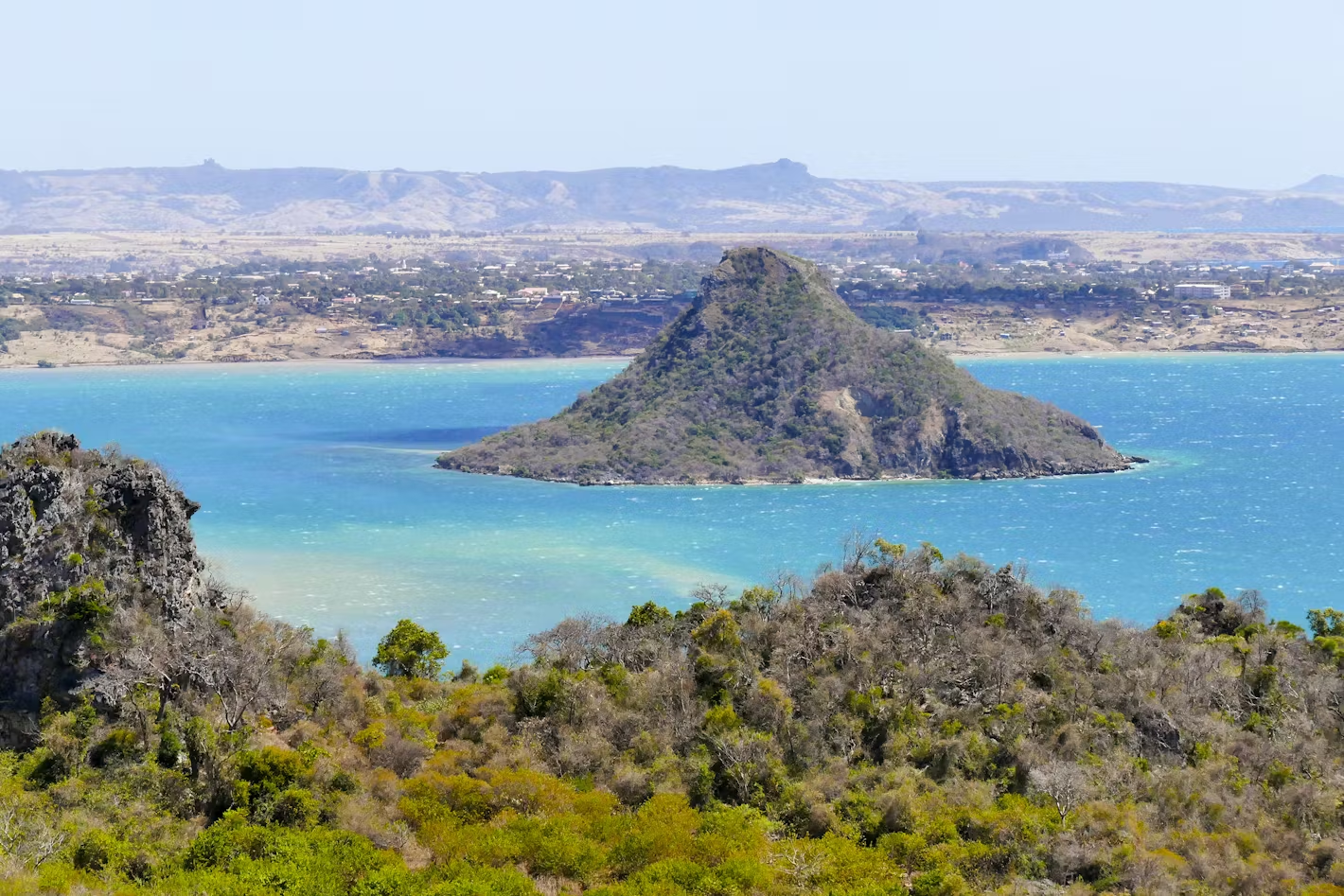
The city nestles beside an ocean bay of gleaming emerald that is protected to the east by Sugar Loaf, one of the planet’s best known mountains. Just a drive away, the landscape transforms dramatically: rainforest gives way to baobab valleys, piquant limestone refracts from the ground and endless white beaches meld into turquoise lagoons.
Diego Suarez is one of Madagascar’s greatest treasures for intrepid travelers after history and landscapes unlike anywhere else in the Indian Ocean.
A City Forged by the Sea
And it begins with the geography of Diego Suarez. For centuries its vast, protected anchorage made it one of the most strategically vital ports of the Indian Ocean. This extraordinary bay was fought over by sailors, traders and pirates.
The bizarre name of the city dates back to two Portuguese navigators from early sixteenth century. In 1500 explorer Diogo Dias, brother of Bartolomeu Dias, was blown off-course travelling to India and became among the first Europeans to sight Madagascar. Well about two years later Admiral Fernão Soares anchored the great northern bay. Gradually, European cartographers merged their names to create the name that would later appear on charts used by ships travelling between Africa, Arabia and Asia: Diego Suarez.
Nothing epitomizes the romance of Diego Suarez quite like the legend of Libertalia. Maritime legend has it that in the late 1600s, a rogue crew of pirates led by Captain Misson and an Italian priest, Caraccioli, established a pirate utopia near one of the bay’s hidden anchors. This community allegedly renounced monarchy, slavery and ironbound caste systems. Pirates, they alleged, of all descriptions lived on equal ground ruled by democracy, sacking ships for the empire while quietly dreaming of a society unfettered by Europeans.
Libertalia is known partly through a passage from a three-masted merchant ship, and historians still argue as to the veracity of its existence or if it was some form of literary device possibly connected to Daniel Defoe. But in Diego Suarez the myth seems almost alive. A coastal landscape punctured by secret anchorages and misty inlets invites the imagination to linger upon how pirate ships might once have slipped discreetly into the pantomime of fog.
The French colonial era above all ingrained its influence into the modern Diego Suarez. France saw the potential for naval base and coaling station here in the late 1900s, knowing it as a strategical point. The sleepy harbour became one of France’s key Indian Ocean military ports as wide boulevards and colonial-era luxury villas sprang up, along with arsenal and administrative buildings.
There are remnants of that time everywhere, even today: colonial facades still mostly intact but faded, ancient barracks, iron balconies, shuttered hotels and palm tree-lined harbourfront avenues. The weathered grandeur of the city — battered but evocative.
It was the Second World War which saw Diego Suarez once again take to the world stage. Britain was worried Japanese submarines would use Vichy-controlled Madagascar as a base from which to target Allied shipping routes across the Indian Ocean in 1942. It therefore initiated Operation Ironclad, the first significant amphibious assault by British forces since Gallipoli. Allied forces captured Diego Suarez and the harbour after several days of heavy fighting. That campaign is still remembered today by military ruins and the Commonwealth War Cemetery.
When Madagascar won independence in 1960, and France withdrew its forces in the 1970s, Diego Suarez lost most of its strategic and military significance. As the now‑busy port began to quiet, colonial buildings crumbled in the tropical humidity and sea winds, rail lines rusted, commerce dwindled. But this decline saved the city too. Instead of developing into a smart resort town, Diego is real – lived in — a melting pot of Antankarana and Sakalava tribespeople coexisting with Indian, Comorian, Arab and French settlers. It is beautifully imperfect.
Unique ambient and extreme shapes
Arriving into Diego Suarez is a surprise to many travelers. It is a lighter city than Antananarivo or any other of the Malagasy cities. The relaxed pace of life and tropical climate is supported by wide streets, constant vistas to the sea and a relatively mild trade wind known as the Varatraza.
Near Antsiranana an extreme diversity of landscapes is crammed into a tiny area. In one day, you can traverse cool cloud forests in Amber Mountain, swim in the electric waters off the Emerald Sea, trek across arid plains lined with baobabs to discover the limestone canyons and tsingy of Ankarana; see kitesurfers carve through iridescent blue satin in Sakalava Bay; and cap it all off with fresh seafood or French-inspired fare overlooking the port. Some of Madagascar’s wildest and most contrasting sceneries meet with Diego Suarez.
Exploring the City of Antsiranana
The managed city itself is worth exploring before venturing out into the wilderness that surrounds it. Colonial architecture rubs shoulders with Malagasy houses, cafés, small shops and market stalls along Rue Colbert, the main avenue. And here is the old French naval town legacy, next to the working life of a northern Malagasy port.
Here the covered market is a riot of colour and scent — vanilla, cloves, pink peppercorns, ylang‑ylang and black pepper from Madagascar, tropical fruits and freshly landed fish. It is loud, busy, and unforgettable. If you stand on Place Joffre, overlooking the harbour, it is possible to make out the yawning bay itself, brittle cranes and frozen ships — physical evidence of the time when Diego Suarez was an important military/mercantile crossroads.
In the meantime locals and tourists zip around in colourful bajaj (tuk‑tuks) that dart between back roads and onto wide streets. Low-cost, useful and raucous; they have become embedded in the personality of a city.
Amber Mountain National Park
Amber Mountain National Park is literally like visiting another planet, a mere forty or so kilometres south of Diego Suarez. It rises to nearly 1,500 metres, managing to moisten any clouds that reach it and producing its own cooler wetter microclimate above the arid lowlands.
The slopes are blanketed in rainforest, where trails pass beneath a heavy roof of tree ferns and orchids swaddled amid moss-dripped trunks and climbing lianas. Other places surely petrified and almost Jurassic in the state of their forest.
Amber Mountain is one of the best locations in Madagascar for seeing chameleons – from tiny leaf chameleons that camouflage perfectly into the leaf litter, to spectacularly bright Panther Chameleons. This is also home to various other northern lemurs, particularly in the mornings and early evenings; Crowned Lemurs and Sanford’s Brown Lemurs.
Tumultuous whitewater plunges among dark volcanic rock into crystal-clear pools, lined in ferns and dripping vegetation at waterfalls like the Sacred Waterfall and the Grande Cascade. The cold air combined with the mist from temps in the forest make it feel very much Jurassic almost.
Three Bays (Les Trois Baies)
A superb sandy drive east of Diego Suarez brought us to the Three Bays, another classic excursion. The route gradually winds past scattered baobabs, dry scrub and petite fishing villages before giving way to the ocean.
The first bay, Sakalava Bay, is open, windy and shallow–you will find it protected by a corral reef. The steady trade winds and flat turquoise water has made it the most well known kitesurf spot in Madagascar. The long pale sand, the bright blue sea and colourful kites carving across the lagoon are complementary to such an extent that they feel fictional.
Further down, Pigeon Bay is a small and more secluded cove—and great for swimming and playing on the sand. Further out, is Dune Bay; a long stretch of sand flanked by shaped dunes and rocky points. The water here is so clear (probably some of the clearest in northern Madagascar), and combined with light on sand, rock and water — especially at sunset — the scenery is about as photogenic coastal scenery you can get this side of Madagascar.
Old French fortifications along the bluff are still there to oversee the entrance to the bay near Cap Miné, prairie and gun emplacements and observation posts offset by scrub oak trees in an area lightly populated. These ruins, slowly reclaimed by vegetation, stand silent witness to Diego Suarez’s strategic position in the colonial era and during the Second World War.
The Emerald Sea (Mer d’Émeraude)
One of Madagascar’s trademark seascapes—the Emerald Sea—stretches off the fishing village of Ramena, northeast of Antsiranana’s main bay. This immense lagoon, protected from the turbulent sea by a barrier of coral reef and sandbank, is incredibly shallow and reflects astonishing hues of pale blue, jade and emerald beneath the tropical sun.
Traditional wooden boats and small motor launches set out from Ramena early in the morning to cross the bay towards a series of tiny sand islets amid the lagoon. The world out here shrinks to water, wind and light. Visitors spend the day swimming in unbelievably transparent water, snorkelling over coral gardens and vibrant reef fish, giving kitesurfing a go or just luxuriating on the sand beneath makeshift shade.
Lunch is often cooked directly on the beach by local fishermen who will grill freshly caught fish and crabs (and sometimes lobster) together with coconut rice. Eating this barefoot in the sand with nothing but sea and sky becomes for many Diego Suarez travellers one of their memories — a defining moment.
French Mountain (Montagne des Français)
French Mountain (840 feet or 256 meters) stands on the eastern shore of the bay and provides an easy drive close to town. The dry forest and scrub of this limestone massif provide some of the best overlooks over Antsiranana and its harbour.
The route upward climbs through shaggy profusions of thorns, pale rocks and the crunchy remnants of French military fortifications that protected the bay from landward invasion. The panorama unfolds gradually as you ascend, red roofs and harbour cranes opening out across the city, then the broad shape of the bay in clover-leafed outline and Sugar Loaf’s water-girt pyramid.
The panorama, especially at sunset, is truly superb from the higher terraces. The light over the sea is gold, the hills are black silhouettes and the entire bay resembles a gigantic natural amphitheatre.
On French Mountain you can also find the endemic and endangered tree species, the baobab Adansonia suarezensis strictly endemic to northern Madagascar. These huge, gnarled trees cling to cliffs and rock faces threatening the landscape with an odd sense of drama.
Ankarana National Park and Red Tsingy
Ankarana National Park literally is the next destination in our itinerary which took us on the way to the red tsingy.
Down the RN6 a little further, Ankarana National Park preserves some of Madagascar’s most extraordinary geology. Tsingy represents a maze of knife-like limestone spires that have been eroded over millions of years by wind and water. These grey tsingy, stark against thick jumbled forests of stone mottled with cracks and canyons, ascend at Ankarana.
This landscape, interspersed with towering limestone slabs that rise into walls filled by neat rows of razor edges and layered sinks, is accessible by foot: trailing between cliffs, ambulating over bridges constructed to span chasms. Below it lies one of Africa’s largest cave systems with subterranean rivers, huge chambers, bats and hidden corridors. Some of the darkest reaches are still said to be home for crocodiles by local stories.
The wildlife is abundant: lemurs, reptiles and rare or endemic birds have adapted to the harsh rock-and-dry-forest terrain of the park.
Another, much different formation lies between Diego Suarez and the park: the Red Tsingy. Instead of limestone, the deep hues of fine-red and pink sandstones have been sculpted into an almost fairy‑tale forest with delicate spires and ridges that rise from the ground like pillars, fins or sails. During sunset the colours become dark oranges and crimsons, as if one were looking at another planet.
Nosy Hara and Cirque de la Baie du Courrier
To the east of Diego Suarez facing the Mozambique Channel, Nosy Hara archipelago and Bay of Courrier is one of northern Madagascar’s most untamed coastal areas. Limestone cliffs shoot straight from the water in dramatic shapes that hint at Southeast Asia but with obviously Malagasy light and wildlife.
Tourist infrastructure here remains minimal. Most of the trips are run as mini experiences, camping on remote beaches under a pristine starlit sky. The island, with little in terms of development, helps it achieve a real expeditional feeling.
Its surrounding waters protect some of Madagascar’s best coral reefs, and house abundant sea turtles, rays and thick schools of tropical fish – making the archipelago a great spot for snorkelling / freediving. Nosy Hara is also known as home of one of the smallest reptiles in the world — the tiny chameleon small enough to sit on top a finger tip: Brookesia micra. And the island cliffs themselves have become a destination for international rock climbers opening routes on these pristine limestone walls high above the sea.
Practical Information
- Best time to visit: September–November (dry season); June–October for kitesurfing and sailing
- Climate: Tropical with distinct dry (April–November) and wet (January–March) seasons; cyclones possible in rainy season
- Access: Domestic flight from Antananarivo to Antsiranana, or overland via the spectacular RN6
- Getting around: Bajaj (tuk-tuks), hired 4×4 vehicles, or guided tours
Conclusion
Diego Suarez remains a frontier today – disentangling two worlds. Where pirate legends still resonate in remote harbors, where ancient towns sand out amongst thick palms, and nature exposes herself—fierce and untamed—all around. In the morning you will float in electric‑blue lagoons, pains to climb among baobabs and limestone in the afternoon, watching the sun sink behind one of the world’s great natural harbours. The further north you go, the less travelled things get, to the point where the road finally peters out and adventure begins.