
One of the true adventures of western Madagascar is the descent of the Tsiribihina River. For three days, the river is the only road. Children in dugout canoes wave at the boats, zebu cross the shallow waters and sandstone cliffs slowly reveal themselves behind green hills.
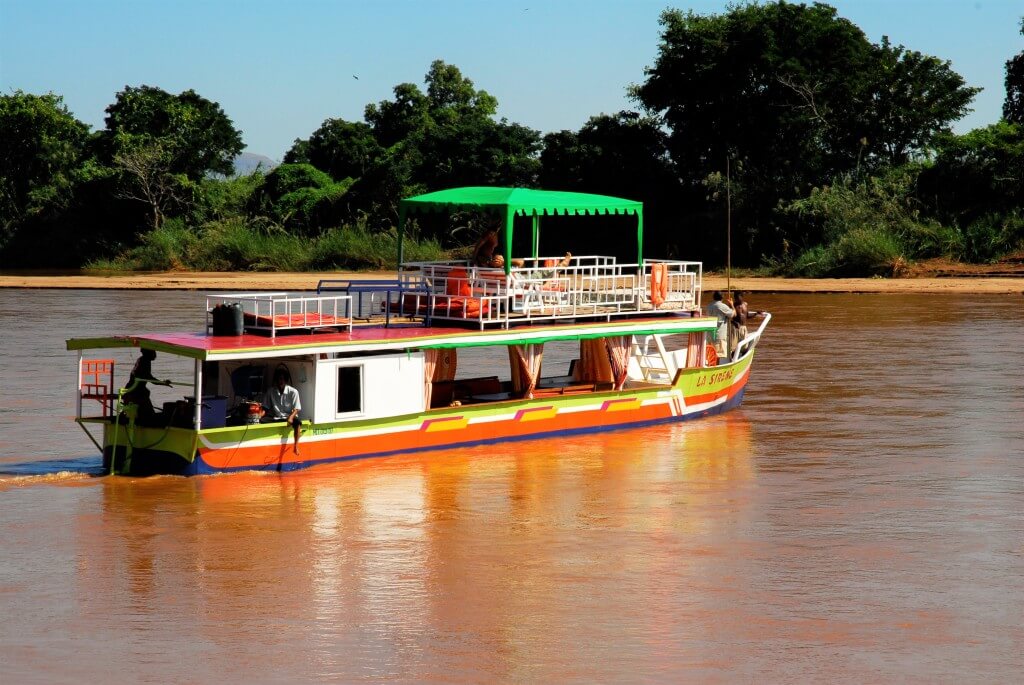
Sailing gently on a private barge allows you to enjoy this journey at a much calmer and, more importantly, more adaptable pace. No group to manage, no imposed timetable or order. In this remote part of Madagascar, time seems to stand completely still.
After a night in Miandrivazo, the main stopover for accessing the waterways of western Madagascar, you take the road downstream. From there, a transfer takes you to Masiakampy, the starting point of the cruise, located about 7 km from the RN34 near Miandrivazo, the gateway to river expeditions in western Madagascar.
Day 01 – Masiakampy → Tsiribihina Cruise → Nosinapela Waterfall → Begidro Camp
After breakfast, we head to Masiakampy and board our private barge to begin sailing the wonderful Tsiribihina River. The first hours on the river are calm and restful. Just lie on the boat and watch the landscapes slowly pass by. You can frequently spot various types of birds along the banks, including herons, kingfishers, wild ducks with their young, parrots or raptors.
Before midday, the cruise passes the first segments of the Bemaraha massif, offering superb views of the dry deciduous forests and rocky cliffs. Depending on the time of year, it is possible to see lemurs in the trees lining the river.
Around midday, a stop is planned at the magnificent Nosinapela waterfall, one of the most beautiful waterfalls encountered on the Tsiribihina. You can swim in one of the natural pools and enjoy a well-deserved rest in the shade after several hours of sailing.
The journey resumes after the lunch break and swim, heading to the Begidro camp. Campfires are lit on a sandbank at the water’s edge. As the sky begins to turn purple, the crew prepares dinner over the fire while the sun sets behind the cliffs and along the banks of the Tsiribihina. Overnight camping by the river.
Day 02 – Tsiribihina Cruise → Berevo → Ambatomisay Camp
A short open-air stop in the village of Begidro to discover local river life before heading to the first camp. You can see traditional houses, a primary school and tobacco fields – one of the main crops in the region. Then the descent continues along the Tsiribihina. During the day, you pass the village of Berevo, which has a small hospital, a Catholic school and a gendarmerie outpost.
The landscape alternates between cliffs, sandbanks, palm trees and, again, small jungle-fringed villages, accessible only by river or by trail. On arrival in the late afternoon near the village of Ambatornisay, you discover the first large baobabs of the three-day journey. A second camp is set up by the river after a visit to the village. The villagers serve us dinner around a campfire, accompanied by a traditional dance. Overnight camping.
Day 03 – End of the Tsiribihina → Tsimafana → Belo sur Tsiribihina / Morondava / Tsingy
Unique landscapes of western Madagascar – rice paddies, baobabs, mango groves and small fishing villages on the river banks – lead you to the end of your descent. Arrival at Tsimafana around midday marks the official end of the boat descent on the Tsiribihina.
From there, several choices are available depending on your itinerary: head north towards Belo sur Tsiribihina and the Tsingy de Bemaraha, so photographed; go south to Morondava to admire the sunset at the iconic Avenue of the Baobabs; or continue to the western regions of Madagascar. End of the trip.
When to go
The best time for the Tsiribihina River descent is generally from April to mid-November during the dry season. Between June and September, temperatures are more pleasant and river conditions are generally stable. During the rainy season, from December to March, heavy rains can affect navigation, the water level and access roads. From August to October, the sky is often clear and sunsets are magnificent along the river.
Tips
- Bring light clothing for daytime sailing, but also something warmer for the evenings, especially between June and August.
- Sun protection is essential. Large sections of the river are fully exposed during the day.
- A dry bag is highly recommended for cameras, phones and electronic devices.
- River conditions change according to the season, so departure and arrival times may vary slightly.
- Don’t expect luxury infrastructure. The beauty of the Tsiribihina lies in its simplicity, isolation and the feeling of total disconnection for a few days.