
Antsirabe – the spa town, a living museum of the Madagascar Highlands
In the heart of Madagascar’s central highlands, surrounded by the volcanic Ankaratra massif, lies a town that seems suspended in time. Antsirabe, capital of the Vakinankaratra region, is often described by travellers as Madagascar’s most “European” city, while keeping a deeply Malagasy soul.
Many consider it just a stop on the RN7, but stay a little longer and you’ll discover a town shaped by geology, royal history and colonial ambitions. Nicknamed the “City of Water” thanks to its thermal springs and volcanic lakes, Antsirabe offers a cool, pleasant climate far from the humid heat of the tropical coasts.
This guide explores the city’s rich and complex history: from the ancient highland kingdoms to the arrival of Norwegian missionaries and the golden age of French colonisation.
1. The history of Antsirabe: between volcanoes and kingdoms
To understand Antsirabe you need to grasp the different historical layers that shaped the town. Unlike many coastal cities in Madagascar, Antsirabe is relatively modern and its growth is closely linked to the discovery of its thermal waters.
The kingdom of Andrantsay and Betafo
Long before Antsirabe became an important town, the centre of regional power was at Betafo, a little further west. In the 17th century this area was known as the kingdom of Andrantsay, prosperous thanks to its fertile volcanic soils.
With the expansion of the Merina kingdom under King Radama I in the 19th century, the region was integrated into the central highland administration. At that time the area of present‑day Antsirabe was mostly a marshy zone famous for its “ranomafana” (hot waters) and “ranovisy” (mineral waters), traditionally used for their healing properties.
The Norwegian influence
One of the most surprising chapters in Antsirabe’s history began in 1869 with the arrival of Norwegian Lutheran missionaries. Pastor T.G. Rosaas immediately understood the therapeutic potential of the thermal springs.
The Norwegians founded hospitals and sanatoriums, but they also left a strong architectural imprint. The many red‑brick churches with tall bell towers that still characterise the Vakinankaratra today are a direct legacy of this Scandinavian influence.
The French vision: the “Vichy of Madagascar”
The real urbanisation of Antsirabe began after the French colonisation of 1896. The colonial authorities were looking for a healthy refuge away from the heat and diseases of the coast and the chaos of Antananarivo.
Antsirabe’s cool climate – where winter temperatures can approach 0°C – and its thermal springs seemed ideal for creating a spa town inspired by Vichy in France.
In the 1920s and 1930s Antsirabe became the favourite holiday spot of the colonial elite. Elegant villas, racecourses, wide tree‑lined avenues and the famous Hôtel des Thermes were built. The town was laid out with broad, straight streets, very different from the narrow alleys of the capital.
The exile of Sultan Mohammed V
In 1954 Sultan Mohammed V of Morocco was exiled by the French authorities and transferred to Antsirabe with his family. For nearly two years the future King Hassan II lived in the town. The sultan attended the local mosque and maintained cordial relations with the inhabitants. Even today Antsirabe retains a small Muslim community and a special historical link with Morocco.
Madagascar’s industrial centre
After Madagascar’s independence in 1960, Antsirabe became one of the country’s main industrial centres thanks to abundant water and its strategic location. Textile industries, tobacco processing and especially the famous Star Brewery, producer of Three Horses Beer, contributed to the town’s growth.
2. Architectural heritage and landmark sites
Walking through Antsirabe means crossing different architectural eras.
The railway station
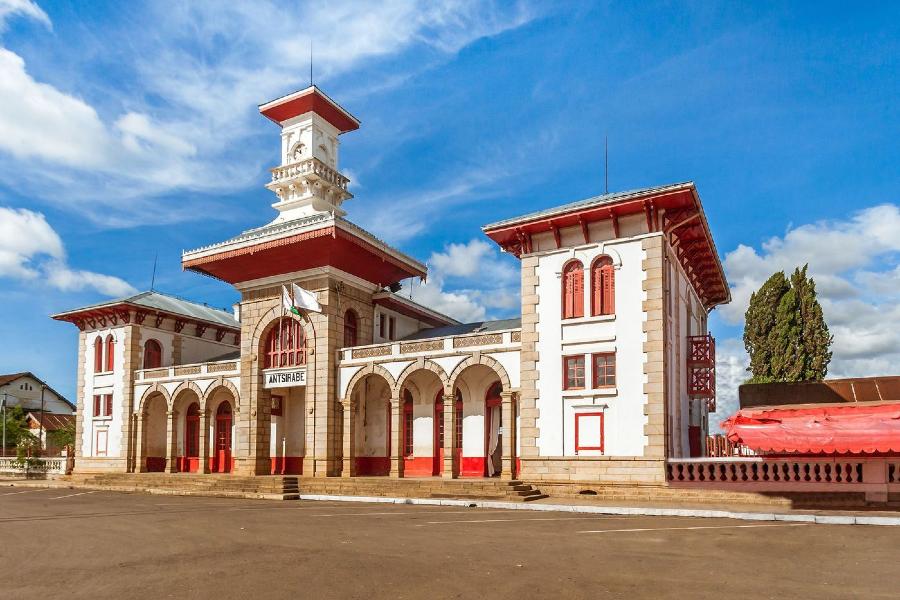
Built in 1923, Antsirabe railway station is one of the most photographed buildings in Madagascar. Its French colonial architecture, with a central tower and large arches, bears witness to the infrastructural ambitions of the time. Even though rail traffic is limited today, the station remains a symbol of past elegance.
Notre‑Dame de la Salette Cathedral
Completed in 1931, this imposing cathedral blends Romanesque and neo‑Gothic elements. On Sunday mornings the forecourt fills with worshippers dressed in white for mass.
The Independence Stele
Located on Avenue de l’Indépendance, it represents Madagascar’s 18 main ethnic groups and symbolises national unity.
3. Natural wonders: volcanoes and legends
The Vakinankaratra region is of volcanic origin and this geology defines all the landscapes around Antsirabe.
Lake Tritriva: the legend of the lovers
About 18 km from town lies the mysterious Lake Tritriva, a volcanic lake with deep, greenish waters. Legend tells the story of two lovers, Rabeniomby and Ravolahanta, who belonged to incompatible castes. Unable to marry, they decided to throw themselves together into the lake. Guides often point out two intertwined trees said to symbolise their souls. According to tradition, cutting the bark releases a red sap resembling blood. The lake is considered sacred and many “fady” (taboos) are still respected.
Lake Andraikiba
Closer to town, Lake Andraikiba was the centre of water sports and leisure activities during the colonial period. Remains of old recreational structures can still be seen, recalling the atmosphere of the 1950s.
4. Crafts and daily life
The art of recycling
Antsirabe is famous for its miniature cars made from recycled materials. Craftsmen use tin cans, tubes and salvaged metal parts to create detailed reproductions of classic cars and Malagasy bush taxis. More than mere souvenirs, these creations represent everyday Malagasy ingenuity.
Zebu horn craft
The zebu is a symbol of wealth in Madagascar. Its horns are heated and shaped to create combs, spoons, jewellery and decorative objects.
The pousse‑pousse
The pousse‑pousse is the ultimate symbol of Antsirabe. Colourful and carefully decorated, they often bear names and slogans reflecting the driver’s personality. Visiting the town by pousse‑pousse is one of the most authentic experiences of the Malagasy highlands.
5. The agricultural heart of Madagascar
The Vakinankaratra region is known as the “breadbasket of Madagascar”. Thanks to the cool climate, crops rare in the rest of the country are grown here: apples, grapes, peaches, wheat and barley.
Around Betafo lie some of the most spectacular terraced rice paddies of the highlands, testimony to centuries of traditional agricultural engineering. Unlike many other African regions, the highlands have a strong dairy tradition. Along the roads it is easy to find artisanal yoghurt, fresh milk and local cheeses.
6. Practical guide for visiting Antsirabe
When to go
The best time to visit Antsirabe is from April to October, during the dry season. Days are cool and sunny, with little rain. The climate is perfect for strolling around town, visiting the volcanic lakes or exploring the surrounding villages and terraced rice paddies. Evenings, however, can become really cold, especially in June, July and August. Do not underestimate the winter of the Malagasy highlands.
How to get there
Antsirabe is about 3.5–4 hours by road from Antananarivo along the RN7. The journey crosses typical highland landscapes: rice paddies, red hills and traditional villages.
Getting around
The town has a grid layout and is easy to navigate. The best way to discover Antsirabe remains walking or using the traditional pousse‑pousse.
Conclusion
Antsirabe is not just a stop on the way to southern Madagascar. It is a town with a unique identity, shaped by volcanoes, thermal springs, colonial architecture and highland traditions. Here the memory of ancient kingdoms, the traces of colonisation and the discreet energy of contemporary Malagasy life coexist. From the volcanic lakes to the pousse‑pousse slowly making their way along the wide avenues, Antsirabe has a special atmosphere that invites you to slow down and take in the details.